From using fake snow to warming temperatures, discover how climate change is affecting the viability of Winter Olympics
By
It is an indisputable fact that the world is warming. Primarily driven by human-caused greenhouse gases, our planet is currently in the hottest decade ever recorded. Such weather extremes have far-flung impacts, including on some of the world’s biggest sporting events, such as the Winter Olympics.
By the 2080s, more than half of the potential host cities for the Winter Olympics will be ‘climate unreliable’, according to a scientific study funded by the International Olympic Committee (IOC) itself back in 2024. By 2050, four former host cities – Chamonix, Sochi, Grenoble and Garmisch-Partenkirchen- would all have unreliable climates for hosting the Games, even under the UN’s best-case scenario for climate change, which assumes the world quickly cuts its greenhouse gas emissions.
Enjoying this article? Check out our related reads…
Even athletes themselves are becoming increasingly concerned with how climate change is impacting winter sports. In a participant survey involving around 400 Winter Olympic athletes, more than 95 per cent stated that climate change has – or will – negatively impact their sport.
Such bleak projections beg the question: what impacts are actually taking place on the ground? How is climate change wreaking havoc on the Winter Games – and is it a reality that cannot be curbed?
Fake snow
When you picture the Winter Olympics, the first image that comes to mind is white, snowy scenes. But back in 2022, Beijing – the host city – appeared starkly different, having received little snowfall that year. That’s when measures were taken to make the Winter Olympics the first games to use 100 per cent artificial snow, in a city that is one of the most water-scarce in the world. The decision was taken to ‘ensure the quality’ at the Games remained high, as this type of snow is harder and wetter, making it more suitable for some sports.
Although fake snow has been relied upon at Vancouver 2010, Sochi 2014 and Pyeongchang 2018, Beijing’s Winter Games used unprecedentedly high levels.
It is estimated that around 222.8 million litres of water were used to produce millions of cubic metres of snow. Clearly, it’s an energy and resource-intensive process to produce artificial snow and requires the diversion of water from existing reservoirs.
However, in the absence of snow-making, the number of climate-reliable potential hosts for the Olympic Games dwindles to just four or less by 2050. Ultimately, while it does have its drawbacks, without snow-making, the Games would increasingly become both unfair and unsafe for athletes.
Warming temperatures
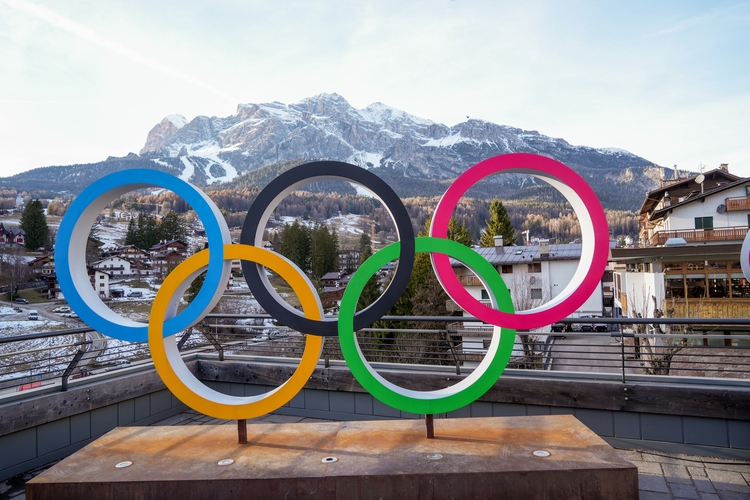
Average temperatures in Cortina, Italy – where this year’s Winter Olympics are being held – have risen by around 3.6ºC since the region first hosted the Winter Olympics in 1956, according to a recent analysis by Climate Central.
The number of freezing days – required for snow to fall – has dropped by almost 20 per cent. As a result, event organisers had to ship in three million cubic yards of artificial snow for this year’s games, despite them taking place in the high altitudes of the Italian Alps.
But it’s not just Cortina that’s feeling the effects of a warming planet. Every host location of the Winter Games since 1950 has warmed since then, according to Climate Central. And out of 93 potential host sites, only 52 would have reliable conditions for the Winter Olympics by the 2050s.
The next Winter Olympics is set to be held in Utah. And while a single season is, of course, not a perfect indicator of future snowfall, Salt Lake City has only amassed 0.1 inches of snow this winter season, compared to an average of 33.4 inches typically accumulated by early February. It’s a stark reminder of how quickly the planet’s once-frigid climates are hotting up.
Changing sports
For certain winter sports, the effects of a warming planet are particularly pronounced. For example, Olympic bobsledding – a high-speed race on an outdoor ice track – requires temperatures that are freezing or below. Although bobsledding takes place outdoors, many tracks require constant refrigeration to maintain those temperatures. However, refrigeration can create frost, making the track slower – presenting fairness concerns for athletes.
Alpine skiing has also been impacted. The sport has seen shortened seasons, with the average ski season in the US already cut by up to a week relative to 1960-1979. Even outside of the Olympics, alpine skiing events have been impacted, with those like the PwC Tremblant World Cup and the Kandahar World Cup suffering cancellations due to warm temperatures and a lack of snow.

Olympic snowboarders have also had to increasingly ‘chase the snow’ – abandoning training grounds with poor snow coverage in search of areas with more abundant and reliable snow.
Technology developments across the past century have helped some sports adapt to a warming climate. Hockey was moved indoors, followed by skating – both sports that can benefit from cooling, refrigerated rinks. Today, indoor skiing facilities make skiing possible for athletes all year round.
The Paralympics in jeopardy
The threat of a warming planet not only puts the Winter Games in jeopardy, but also the Paralympic Games. Since 1992, the Paralympic Games have been held approximately one month after the Olympic Games in the same location, typically in March when temperatures are warmer.
Projected shorter Northern Hemisphere winters by 2100 could put outdoor competitions in March even closer to when spring occurs, raising concerns over reliable, safe and fair conditions for competing athletes.
By the 2050s, only 24 per cent of the 93 potential host cities for the Paralympic Winter Games will still have reliable conditions in a mid-range future warming scenario. However, in a high-emissions scenario, the ability to hold the Paralympic Games in March is almost eliminated by the 2080s, when just four of the 93 potential hosts will have reliable climate conditions.
To address this scenario, expert analysis indicates that holding the Winter Olympics and Paralympics three weeks earlier in the year has ‘tremendous potential’ to increase the number of climate-resilient hosts. In fact, it nearly doubled the number of climate-reliable host locations for the Paralympics, helping to safeguard the ‘one bid, one city’ arrangement.