
As shrimp farming expands, the world’s mangroves disappear, leaving coastal communities, wildlife and climate increasingly vulnerable

By
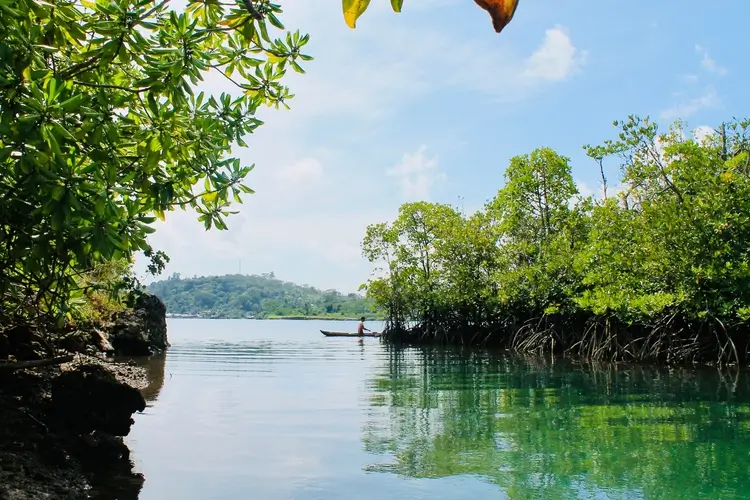
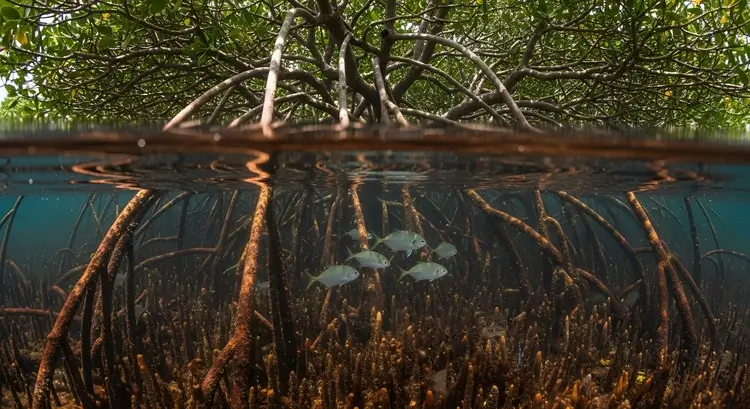
Where the land meets the tropical sea, a strange and vital forest grows with its roots in the tide. Mangroves are nurseries for fish, walls against storms, and some of the most efficient carbon stores on the planet, holding more per hectare in their waterlogged soils than almost any forest on dry land. They are also vanishing three to five times faster than forests as a whole, and roughly two-thirds of the world’s mangroves have already been lost or degraded.
Related reads…
It is tempting to describe this as tragic, as though it were an accident. It is not. It is the deliberate result of a way of doing business.
To understand the destruction, you have to understand what is being taken. The mangrove itself is almost never the prize. It is an obstacle standing in the way of profitable farmed shrimp. Across the tropics, coastal forests are cleared, their tidal channels blocked, and the ground carved into shallow ponds where shrimp are raised in enormous numbers for export to richer markets. The forest is not harvested; it is erased and replaced by a grid of chemically managed pools. Because those pools sicken with disease and their soils sour within a few years, they are frequently abandoned, and the operation simply advances to the next untouched stretch of coast.
While shrimp cultivation is one of the main causes, in some regions the forest is cleared for oil palm or rice, again grown for distant buyers rather than local tables. In others the extraction is literal, because where mangroves sit above oil, the drilling, spills and pipelines poison the very soils the trees need to survive. The commodity changes; the structure does not. In every case a shared resource that once fed and sheltered an entire community is enclosed, converted into a single export product, and drained of its true value.
Mangrove destruction
While we all pay globally for the loss of such important habitats and carbon stores, the local fishers, crabbers and shellfish gatherers who have depended on these forests for generations under customary rights suffer imminently. The sequence is grimly predictable: the common land is privatised, the ecosystem collapses, and poverty deepens. Because those communities have no deeds to wave and no authorities on their side, their resistance is easily brushed aside, sometimes with a permit, sometimes with a threat.
Latin America has long suffered from the destruction of mangroves. From the 1980s, Honduras saw shrimp farming spread across a great tidal gulf with no real plan, turning protected wetlands into one of the largest concentrations of farmed shrimp in the hemisphere. Hundreds of hectares of legally protected forest were converted into ponds without licences, or with licences waved through in days. What shielded the operators was not the law but its collapse. The high profits available meant rather than uphold the law, police and soldiers were deployed to guard illegal ponds, and officials looking the other way. Only a stubborn movement of local fishers has kept up the fight, but the distruction of mangroves continues to this day, and Honduras shrimp still turns up on the shelves of British and European supermarkets.
Ecuador too lost around three-quarters of its mangroves in the closing decades of the last century, and the pressure has only grown. Shrimp production has nearly quadrupled in a decade and overtaken oil as the country’s leading export. Ponds now cover more ground than the mangroves that survive. Despite formal bans on clearing, thousands of hectares have disappeared in just a few years, much of it inside areas that are supposedly protected. Enforcement is a fiction: one stretch of coast with hundreds of farms is left to a single inspector with no vehicle. The intimidation is familiar, too those who speak out describe threats to their lives, while polished eco-certification schemes smooth the industry’s path into Northern supermarkets and quietly launder its reputation.
The same machinery runs far beyond Latin America. In Southeast Asia the overwhelming majority of human-driven mangrove loss has been concentrated in a handful of countries, driven first by shrimp ponds and now increasingly by plantations of oil palm and rice destined for export. In the Niger Delta the commodity is crude, and decades of drilling and spills have wiped out vast tracts of forest, the oil-soaked soils bleeding contamination back into the water.
Protecting the world’s mangroves
Protecting mangroves means recognising and defending the rights of the communities who actually guard these forests, and refusing to pretend that cheap shrimp and cheap palm oil come without a cost. Buyers and governments in wealthy markets must demand real accountability rather than reassuring labels; states must enforce the protections already written into their own laws and properly fund the people meant to police them; investors must stop bankrolling the next round of clearance. And the rest of us can stand behind the coastal communities who have refused to give up. The choice could not be plainer: protect a living ecosystem, or let the corporate gangsters finish the job.