
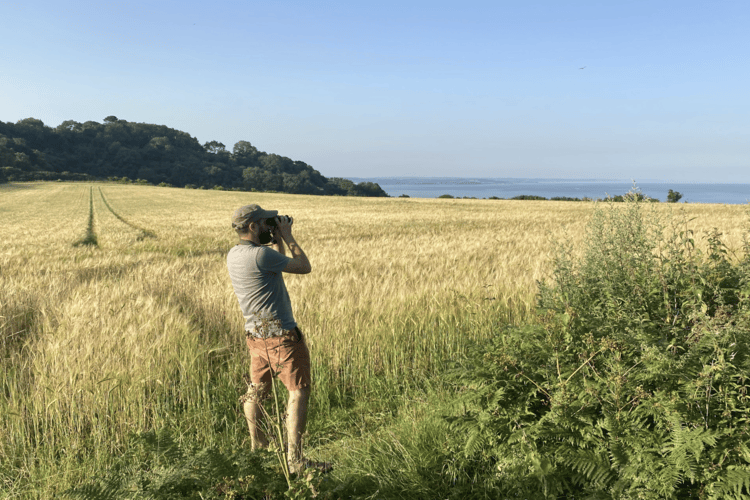
Naturalist Michael J Warren shares with Bryony Cottam his tips on getting more out of your travels
Michael’s travel insights
– There’s fantastic wildlife on your own doorstep
– Go for a staycation rather than getting on a plane
– Discover more about the local lansdcape by learning what place names mean
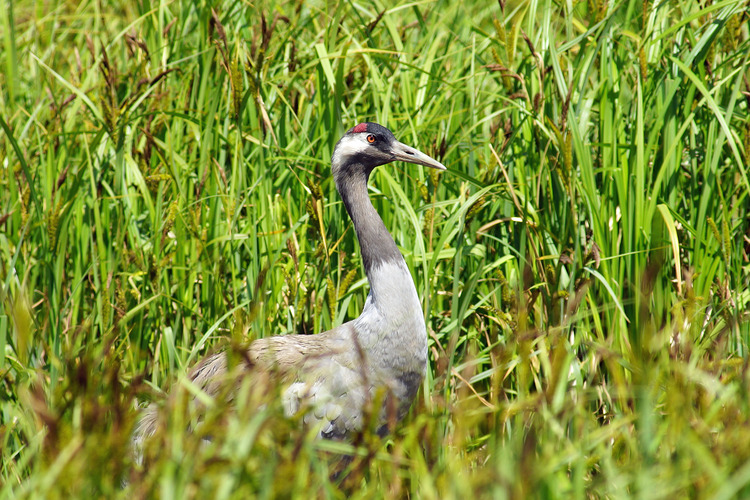
Cranes were once a familiar sight across Britain. We know this because, as author and naturalist Michael J Warren explains, there are more references to cranes in our place names than any other bird – and birds have influenced the way we think about places for centuries. In his book The Cuckoo’s Lea, Warren travels the length of England, and parts of Wales and Scotland, to explore our lost connection to Britain’s once-common, now increasingly threatened, birds.
‘I just let the birds guide me, really,’ says Warren. ‘I went where I thought I might find the most interesting stories for myself, and for readers, about why iconic birds like the cuckoo, the eagle and the crane mattered so much to people that they persistently named places after them.’
Enjoying this article? Check out our related reads…
Warren describes place names as a key to the past, hinting at how towns and villages came to be and the people who once lived there. ‘I would encourage people to get into place names, to learn their basic components. They’re such a significant part of a place, but barely anyone gives any thought to names at all.’ Books and websites – including The Cuckoo’s Lea and The Birds and Place Project, a website Warren dedicates to recording and exploring the birds of English place names – are a good place to start.
As you travel, Warren suggests taking the time to look at road signs. ‘You’ll start to see how some components turn up a lot, endings like “ham” for instance, which give clues to the local geography. Once you’ve learned these elements, you can actually start to navigate the landscape according to these old words. The name Hawkhurst, for instance, which is a village in Kent, means the “wooded hill of the hawk”. So when you see the ending “-hurst”, you know that there must be a wooded hill nearby.’
The great thing is that understanding place names doesn’t just help travellers in the UK. ‘It’s a game that you can play absolutely anywhere you go,’ says Warren. ‘There are fascinating ancient histories and cultures recorded in old place names everywhere. You can enter new worlds and cultures just by paying attention to the names of the places that you visit on your travels.’
While some of the places Warren visits, such as Hawkhurst, still reward visitors with sightings of the birds that inspired their names, others – such as Yaxley (derived from the Old English for ‘cuckoo wood’) – have sadly lost all connection to the landscapes that originally defined them. In the UK, we’re increasingly disconnected from the natural world, which leads some people to think that there isn’t much nature here at all.
‘There is some truth there, in that Britain is the most nature-depleted country in the entirety of Europe, which is not a claim that any of us would want.’ Warren says he understands why people seeking exciting wildlife often book trips overseas, but that we shouldn’t overlook what can be seen during a staycation, or holiday in the UK.
‘Going abroad has become associated with the unfamiliar and with the exotic, and that’s what people have become used to over the 20th century. There’s a cultural perception that that’s what a holiday or travelling is meant to be. But a lot’s been done in the last decade to try to overturn some of the negative perceptions we have of British nature, and TV series such as David Attenborough’s Wild Isles have certainly helped open a lot of people’s eyes to the fantastic wildlife that is on our doorstep.’
For an up-to-date guide to the interpretation of the names of England’s cities, towns and villages, visit kepn.nottingham.ac.uk. The Cuckoo’s Lea is available to buy at linktr.ee/cuckooslea


