
• Skip to main content
  • Skip to secondary menu
  • Skip to primary sidebar
  • Skip to footer
Geographical

Geographical

Official magazine of the Royal Geographical Society (with IBG)

  • Geographical Home
  • News
  • Features
  • Opinion
    • Climatewatch
    • Front Lines
  • Podcast
  • Travel
    • Discovering Britain
    • Passport
  • Culture
    • Book reviews
  • Quizzes
    • Crosswords
  • Choose Geography
    • University directory
    • Masters courses
    • Course guides
      • Climate change
      • Environmental science
      • Human geography
      • Physical geography
    • University pages
      • Aberystwyth University
      • Brunel University
      • Cardiff University
      • University of Chester
      • Edge Hill University
      • The University of Edinburgh
      • Newcastle University
      • Nottingham Trent University
      • Oxford Brookes University
      • The University of Plymouth
      • Queen Mary University of London
    • Geography careers
      • Charity/non-profit
      • Education & research
      • Environment
      • Finance & consulting
      • Government and Local Government
    • Applications and advice
  • Magazine
    • Issue previews
    • Subscribe
    • Manage My Subscription
    • Special Editions
    • Geographical Archive
    • Advertise with us
  • Subscribe
    • Direct Debit Changes

Review: Great Kingdoms of Africa by John Parker

19 May 2023
2 minutes

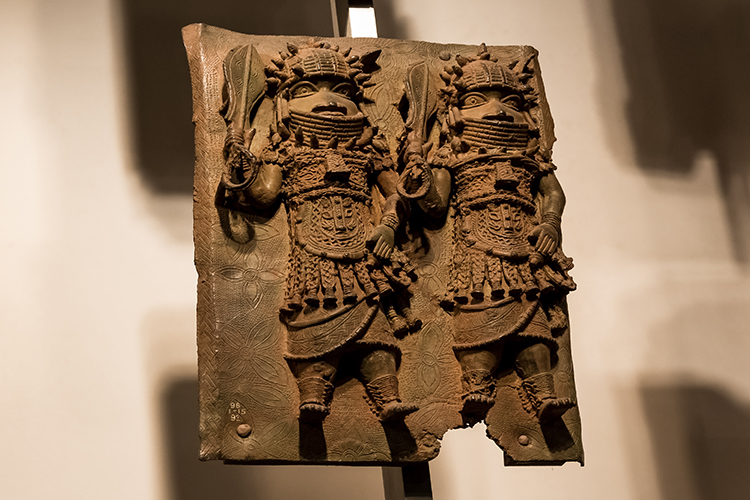
Architectural detail of The Benin Bronzes, group of sculptures created from at least the 16th century in the West African Kingdom of Benin displayed at the British Museum
The Benin Bronzes on display at the British Museum. Image: Shutterstock

Illustrated with fantastic images of artefacts and landscapes, Great Kingdoms of Africa enlightens readers on the rich history of the continent before the brief period of European colonisation


Review by by Mark Rowe

It was never enough for Europeans to exploit the peoples of Africa; we also decided that Africans had little history of their own worth studying. Great Kingdoms of Africa goes a long way to addressing this marginalisation, looking far back to a time before the brief interlude of European colonisation came and went.

The central theme is that of ‘kingship’ – how hundreds of kingdoms have risen and declined over 5,000 years of recorded African history. Geography turns out to be an important denominator, with kingdoms emerging from savannah, forest, the Sahel and the Maghrib. Nine kingdoms are documented by a variety of authors, ranging from Ancient Egypt and Nubia to Buganda, which covers much of the Great Lakes area from Burundi to Uganda and South Sudan, and the West African Sudanic empires, which spanned 1,000 years.

For the European reader, this – after a meandering foreword and introduction – is an enlightening non-colonial history that addresses a question that comes to mind: other empire builders from Alexander to Darius enjoyed the moniker ‘The Great’, so why, for so long, were African kings (and queens) simply described as ‘savage’ or ‘barbaric’?

One would hope that the ‘noble savage’ trope was debunked decades ago, but were any more nails required for that particular coffin, then this book provides them. In Parker’s own chapter on the Akan Forest Kingdom of Asante – incorporating modern-day Ghana – the author notes how 19th-century British diplomatic missions would wait while the king presided over his ‘fetish week’. A traditional account might stop there, securing an amusing anecdote about ‘funny’ customs of people far away. Instead, Parker elaborates and places such traditions in their context and emphasises the oral traditions that offer deeper insights into the Akan peoples. Elsewhere, we learn just how historically unusual it was for women to command meaningful power, for example, in the world of Kushite politics; and of the 15th-century trade routes in copper and raffia that buoyed the kingdom of Kongo. 

For much of the book, academic rather than fluent writing prevails but, illustrated with fascinating images of artefacts and landscapes, this is a series of separate histories of a continent with a past as rich, varied and flawed as Europe’s. 

Themes Book Reviews May 23

Protected by Copyscape

Primary Sidebar

SUMMER SALE

GEOGRAPHICAL WEEKLY LOGO FREE - Sign up to get context, clarity and perspective in a noisy world, every Friday

Popular Now

August 2026 Geographical crossword

August 2026 Geographical crossword

The new study led by the University of Cambridge has revealed that as our springs and summers get hotter and drier, the UK wildfire season is being stretched and intensified.

Geo explainer: The growing problem of UK wildfires

Firefighters tackling wildfires

Geo explainer: What are fire clouds?

Underwater cables

The new geopolitics of undersea data cables

Matthew Hollingham

Travel tips with endurance fundraiser Matthew Hollingham

Footer

  • Facebook
  • Instagram
  • LinkedIn
  • Reddit
  • TikTok
  • Twitter
  • YouTube

Geographical print magazine cover

Published in the UK since 1935, Geographical is the official magazine of the Royal Geographical Society (with IBG).

Informative, authoritative and educational, this site’s content covers a wide range of subject areas, including geography, culture, wildlife and exploration, illustrated with superb photography.

Click Here for SUBSCRIPTION details

Want to access Geographical on your tablet or smartphone? Press the Apple, Android or PC/Mac image below to download the app for your device

Footer Apple Footer Android Footer Mac-PC

More from Geographical

  • Subscriptions
  • Get our Newsletter
  • About Us
  • Contact Us
  • Advertise with us
  • Privacy policy
  • Terms & Conditions

Copyright © 2026 · Site by Syon Media